Mind: Your Personal Enemy (NOT)
This post includes an original song-video that playfully reflects it.
As Sun Tzu once said, “Know your enemy” – but how well do we actually know our minds? Do we know what the mind is? Or where the mind is? Or how the mind is?
Normally, when we say “mind,” we think of the brain. Even though the mind, as a subtle form of energy, isn’t located only in the brain or the head – rather the whole body exists within the mind. But if that’s too much for your rational “mind” to accept, then let’s start with the brain.
The human brain is about 73-75% water, while the human body begins life with similar percentages, but this decreases as we grow older:
- Infants: 75-78% water (more water, less fat)
- Adult men: ~60% water
- Adult women: ~55% water (women usually have more body fat, which contains less water)
- Elderly: 50-55% water (water content decreases with age)
This is why staying hydrated is important, not just for the body but for its main piece of hardware – the brain – as well. When we look at the other main components of the brain (fat 10-12%, proteins 8-10%, carbohydrates ~1%, minerals and salts ~1%), it becomes clear that we don’t really have an excuse for all those sodas, energy drinks, and coffees we consume daily so that “our brain can function properly.”
Aside from drinking it, water is absorbed best when it comes from high-water-content food – but for that, you’d need to eat fresh fruits and vegetables and cook healthy vegan meals. Why bother when there are shelves and shelves of dry, months-old food filled with preservatives, added sugar, salt, and fats? Ironically, it’s called “long-shelf-life food” – for short human lives, Zverce would say.
And it’s not just dry food that can make your brain feel “dry” and foggy – alcohol does that too. Alcohol is a diuretic (i.e. it makes you pee more), which reduces total body water. Some of this water loss affects your brain, leading to mild dehydration. Less water in your brain = slower neuron signaling → headaches, fatigue, poor concentration. When metabolized, alcohol turns into acetaldehyde (a toxic compound) that can cause nausea, fatigue, and irritate your nervous system… yadda yadda yadda – who cares, give us one more round.
Now, let’s dig deeper – or to be precise, dig outward. Here are the five Koshas, or sheaths of the human being, according to Yogic tradition:
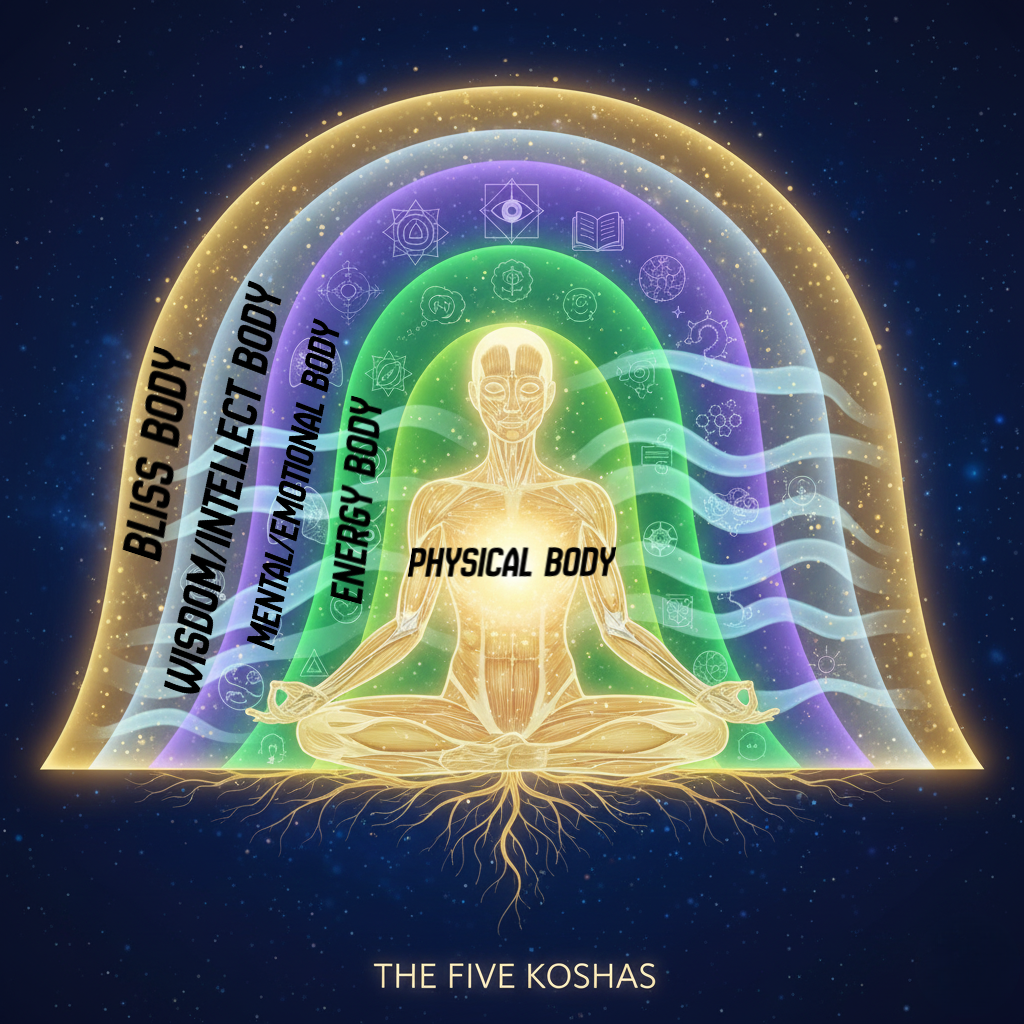
- Annamaya Kosha – Physical Body (Food Sheath)
- The outermost layer, made of flesh, bones, muscles, and blood
- Sustained by food; physical health depends on diet and exercise
- Pranamaya Kosha – Energy Body (Vital Sheath)
- The life-force layer, made of prana (vital energy)
- Controls breath, circulation, digestion, and energy flow
- Practices like pranayama nourish this sheath
- Manomaya Kosha – Mental/Emotional Body (Mind Sheath)
- Governs thoughts, emotions, desires, and sensory processing
- Meditation and mindfulness help purify this layer
- Vijnanamaya Kosha – Wisdom/Intellect Body (Intuition Sheath)
- The discriminative mind, intuition, conscience, and higher intellect
- Enables insight, self-reflection, and discernment
- Cultivated through study, self-inquiry, and meditation
- Anandamaya Kosha – Bliss Body (Joy Sheath)
- The innermost layer, pure bliss and spiritual joy
- Beyond mind and intellect, experienced in deep meditation or Samadhi.
Coming from the socially accepted premise that our mind is our brain, or at least begins there, a healthy brain should mean a healthy mind (considering everything previously stated). So that’s the first step: the wellbeing of both the brain and the body. Since we take in so much every single moment – air, water, food – it makes sense that the body must also remove an equal amount of waste. Clearing out the waste products our bodies naturally generate, along with small chemical exposures from the environment, is part of the detoxification process.
After breathing – which removes carbon dioxide – the next most supportive method is Yoga. Perspiration comes after that, but contrary to popular belief, it removes only a small amount of toxins; its main purpose is cooling the body and helping maintain fluid balance.
But why is Yoga so effective? It doesn’t directly remove toxins; rather it helps the body function better so the liver, kidneys, lungs, etc. – the actual toxin removers – can do their jobs more efficiently. And the way Yoga does this is especially important for the brain. Through gentle muscle contractions, controlled breathing, inversions and posture changes, relaxation, and stress reduction, Yoga supports the lymphatic system. Because the lymphatic system interacts closely with the endocrine system, Yoga also influences hormone activity – and that’s where the key to a happy, equanimous mind lies.
We all know that human experience is essentially a soup of various chemicals called hormones produced by the endocrine glands. And if the “soup” has the right ingredients, it tastes good – and the one experiencing that flavor, your mind, gets to enjoy it.
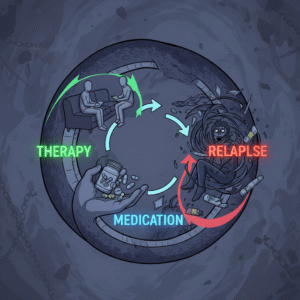
But when the taste is sour, bitter, or salty – or all three – then all of a sudden “know thy enemy” becomes clearer. That same mind, with its (your) thoughts, emotions, desires, aversions, cravings, fears, and judgments, all mix together, and instead of a delicious soup, we end up with something that feels spoiled. When the “menu” is this unpleasant day in and day out, depression, anxiety, and other mental illnesses are just around the corner. And then the well-known cycle can begin:
Therapy → Medication → Relapse → Therapy → Medication → Relapse → Therapy…
The main issue with therapy is that it doesn’t work. Initially, you may feel relief from talking openly with someone, sharing anything on your mind without judgment. For a brief moment, it feels like you don’t have to carry the burden alone. But then you walk out of the office, and the realization hits – you’re still facing the same issue. Over time, even this relief may stop providing tangible benefits, which is why some people visit therapists for years. How is that effective? If it truly worked, shouldn’t it eventually resolve the issue? Even full recovery from open-heart surgery doesn’t take more than a few months.
What a good and honest friend could tell you in five minutes, you may end up spending month – or years – paying for in counseling and therapy.
Before you do that, it’s worth taking a closer look at your friendships. Ask yourself:
Do my friends listen to my issues deeply and fully?
Do they tell me the truth – even when it’s uncomfortable to hear?
Do they genuinely want what’s best for me, not what’s easiest?
If the answer is yes, go and talk to them.
Once your blind spots are clearly named and the core issue is identified, the real work is no longer analysis – it’s implementation. Without that shift, it’s easy to fall into an endless loop of talking, interpreting, and revisiting the same patterns on expensive couches.
At some point, you have to recognize that you’re trying to win a mind game against the mind itself- the game designer. In that arena, you’re bound to lose, even when you feel certain you’re winning.
It’s like trying to open a locked door with another knob. You can’t insert one knob into another, let alone unlock it. You need a different instrument – a key (or the hands of an experienced thief). It’s the same with therapy: you’re trying to solve the mind’s problems using the same mind, the same instrument. If the mind, which created the problem in the first place, could easily solve its own issues, those issues wouldn’t exist at all. Yet the mind, the most elaborate and sophisticated machine known to man, can be remarkably cunning. It may offer small clues here and there – just enough to maintain the illusion of progress. This cunning comes from the mind’s instinct to protect its own existence at any cost, even if it comes at your expense. As a result, you may feel that you are making progress, only to come full circle and have the illusion shattered once again.
Simply put, therapy as a conversation on its own is not effective in the long run. The reason some people feel like it works for them is because of the “tools” they’re taught during therapy sessions. But these tools are not therapy itself. They are skills that our parents, schools, and society often failed to teach us, even though they existed long before today’s high-paying listening professions came along. Tools like breathing techniques, building healthy habits (sleep, study focus, organization), using music, movement, or hobbies to decompress, planning and scheduling, and so on. So, we should give credit where credit is due, and these ancient tools should not be credited to a profession that is barely a century old.
Always keep in mind that the mind is a bottomless hole. Trying to fully figure it out by dissecting one layer at a time – out of its countless layers – may give you a short-term reward for removing one layer, but also lead to a long-term delusion of endless mental gimmicks. One of the major downsides of some forms of psychotherapy is that it can make a person overly analytical and rational – constantly trying to find causes and reasons for everything happening around them and within them. Over time, this can lead to a loss of spontaneity.
When we were children, there was no constant dissection or analysis in our minds. We were free to be our natural selves, expressing emotions without fear and fully enjoying the moment. As adults, however, when we remain stuck in our heads – always trying to understand the background and causation behind every event – our natural self slowly gives way to a more rigid and controlled version of who we are.
Children are carefree and spontaneous. They express themselves without regret, which allows them to be the joyful, natural beings they are. Analytical thinking, when overused, can make one rigid in behavior. As spontaneity is lost, emotions are pushed aside. Relying primarily on the rational mind means dwelling almost entirely in thought.
You can either live in constant psychological analysis or be present in existential reality. The two cannot fully occur at the same time. The more you dwell in your mind, the less attention you give to what is happening in you and around you – always justifying events and searching for causes. The less grounded you are in existence, the less alive you become. Slowly, one turns dry, like an autumn leaf mistaking itself for the vibrant life of spring.
You can live in what you call your rational mind – an identity shaped by accumulated information and experiences, different for every individual despite overlaps. Or you can live in the present moment, in existential reality, which is the truth for everyone. You can either pay attention to what your mind is producing and calling reasoning, analysis, and critical thought, or you can become a silent witness and attend to life within and around you without labeling or justification.
Introspection has its place. It is healthy to reflect occasionally and see whether you are growing or stagnating. But it should be a flavor added to your being – not its core – because the mind’s constructions are ultimately made up. The less you express your true nature, the more you suppress your feelings, suffocating an essential part of yourself.
Eventually, this suppression seeks expression. People then engage in drastic external changes – altering their appearance, lifestyles, or identities – because deep down they feel unseen and misunderstood. Yet this expression is often not the discovery of the “true self,” but a reflection of an inability to truly see and accept oneself.
Medication works differently. It chemically affects our brains and body chemistry, producing tangible results – but at what cost? It can quickly alter a mental state we’ve cultivated over years, if not decades. Such an aggressive approach often comes with side effects and raises questions about sustainability once the medication is stopped.
When trouble comes knocking, it is both valid and necessary to use everything at our disposal. Therapy and medication are two of the best tools modern medicine offers, and the sooner we use them, the better. But why wait for desperate times that demand desperate measures? Just as our thoughts affect our emotions, and our emotions affect our breath, the reverse is also true – this two-way street can be consciously influenced.
For example, when you’re excited or afraid, your breathing speeds up. Different emotions, yet the same impact on your breath. Similarly, when you’re happy or sad, your breathing tends to slow and deepen, with subtle variations reflecting each emotional state. This shows that the mind affects the breath – but it also works the other way around. By consciously changing your breathing patterns, you can directly influence the mind and its behavior. This practice is called pranayama, also known as yogic breathing.
Pranayama directly affects the Pranamaya Kosha or Energy Body, which in turn allows the Manomaya Kosha or Mind Sheath to be influenced. This is done through meditation. Any mindful activity – whether washing dishes, flying a plane, or playing tennis – can reduce mental chaos, calming thoughts, emotions, and mental chatter. Once the mind is clear and calm, insight and intuition can arise from the Vijnanamaya Kosha, the Wisdom or Intellect Body. This is also the source of creativity.
It’s important to note that different Yoga practices affect different Koshas. For example, Hatha Yoga primarily focuses on the Annamaya Kosha and the Pranamaya Kosha. Kriya Yoga targets the deeper, more subtle layers, particularly the energetic and mental koshas such as Pranamaya, Manomaya, and Vijnanamaya (and sometimes Anandamaya). The link between these practices is clear:
Take care of your Physical Body through movement, practice pranayama regularly to strengthen your Energy Body and ease fatigue and stress, and then finish with a 10-15 minute meditation session to nurture your Mind and Intellect. If the meditation deepens into a state like Samadhi, you may even touch aspects of the Bliss Body – like a final “cherry on top” of your mental hygiene.
Since some of you may still roll your eyes when reading about Koshas or the invisible layers of the human being, Zverce invites you once again to keep an open mind and remember that just because you don’t see something doesn’t mean it isn’t there. As a kid, Zverce had no clue about gravity, but that didn’t make it any less real – it reminded Zverce every time Zverce tripped and fell.
Modern medicine continues to show that the “mind” isn’t limited to the brain alone. Some of the most interesting observations come from organ‑transplant cases, in which recipients report unexpected changes, such as:
- Tastes and Cravings: Recipients suddenly developing strong cravings or aversions to foods they never liked before. One of the most famous cases involved Claire Sylvia, a heart and lung recipient who suddenly developed a craving for beer and chicken nuggets, which matched the preferences of her 18-year-old male donor.
- Hobbies and Talents: Recipients acquiring new, previously absent interests, sometimes in artistic or vocational fields connected to the donor’s life. One report detailed a teenage girl who, after receiving the heart of an 18-year-old boy who wrote songs, was able to complete the phrases of a song he had written, despite never having heard it before.
- Emotions and Identity: Changes in temperament, emotional responses, or even sexual preference. One case involved a 47-year-old man who, after receiving the heart of a 17-year-old African-American male, developed a profound and sudden love for classical music (the donor’s passion).
- Specific Memories/Dreams: Instances where recipients have vivid dreams or intrusive thoughts that later align with specific, often traumatic, events in the donor’s life. A compelling case involved an 8-year-old girl who received the heart of a 10-year-old girl who had been murdered. The recipient reportedly had horrifying nightmares of the murder, which were so detailed that they were eventually used to help identify the killer.
These experiences suggest that certain faculties once attributed solely to the brain might not be exclusive to it. No one is asking you to accept all of this blindly – simply try the practices for yourself, and if they work, just do them. So, do it.
copyright © Zverce 2025